
Choosing an automatic power factor correction (APFC) panel starts with the way the load operates, not the number on the cabinet. A bank that covers the peak demand may still have steps that are too large at night. A compact smart-capacitor assembly may still need a separate review of its harmonic suitability. An SVG (static var generator) may offer functions the project does not actually need.
For reasonably steady reactive demand, assess a stepped capacitor bank first. Where harmonic conditions create resonance or capacitor-overload concerns, evaluate a coordinated reactor-and-capacitor arrangement. Where demand changes rapidly, compare dynamic capacitor switching, an SVG or a capacitor–SVG hybrid scheme. If the project needs both inductive and capacitive reactive output, confirm that capability in the selected SVG or coordinated hybrid system. Each choice depends on the operating data and the proposed equipment.
This guide explains six decisions to make before approving a configuration. It covers low-voltage project selection; the separate APFC capacitor-bank sizing guide contains the capacity calculation and worked example.
1. What must be corrected, and during which operating modes?
Start with the measurement point where the required power factor must be achieved. A utility meter, a main distribution bus and an individual motor feeder describe different boundaries. Put that point on the single-line diagram before comparing cabinets.
For an existing installation, collect representative active power, reactive power and power-factor records. Include the lowest normal operating load, a typical working period and the peak production period. If the project is new, use the load schedule and expected operating combinations, with assumptions identified. Schneider Electric's guidance on determining the compensation level provides background for both situations.
Keep three questions together:
- What target does the utility or project specification require?
- How does the reactive demand change as equipment starts, stops or changes speed?
- What correction already exists in the installation?
Transformer kVA describes supply capacity; it does not establish the connected load's compensation requirement. A single peak reading is also a weak basis for automatic operation throughout the day. The selection should address both the required total output and how little correction is needed during normal light-load operation.
Also confirm whether the meter reports displacement power factor (cos φ) or true power factor. Capacitors correct fundamental lagging reactive demand; adding kVAr alone does not resolve a low true power factor caused mainly by harmonic distortion. Schneider explains why these two power-factor measurements differ.
2. Which compensation approach fits that demand?
The first choice is between capacitor compensation, electronic reactive-power regulation and a coordinated combination of the two. A reactor-equipped capacitor bank remains a capacitor-based solution; the reactor addresses a different question from whether electronic regulation is needed.
| Approach | A useful reason to evaluate it | What to establish before selecting it |
|---|---|---|
| Stepped capacitor bank | Reactive demand changes slowly enough for discrete stages to follow it | Minimum demand, stage sizes, switching duty and harmonic suitability |
| SVG | The project needs finer regulation, rapid adjustment, or both inductive and capacitive reactive output | Required operating range, response, phase arrangement and the specific module's functions |
| Capacitor–SVG hybrid | A recurring portion of demand may be covered by capacitor stages while an SVG regulates the changing portion | Capacity allocation, measurement points and how the two controls avoid opposing each other |
For capacitor-based proposals, review harmonics before approving a plain bank. VFDs, UPS systems and rectifiers are reasons to gather better information about the network. Their presence alone does not select a particular reactor ratio. Where the assessment supports a detuned design, the reactor, capacitor voltage, stage output and thermal arrangement need to be selected together. A detuned bank is not a general promise to remove all harmonic currents. See Schneider Electric's harmonic-compensation guidance.
For SVG or hybrid proposals, ask which functions the chosen equipment actually includes. Reactive-power compensation, harmonic filtering, phase balancing and neutral-current compensation are separate performance questions. TDK's PQvar product information illustrates why topology and model details matter; its ratings are not specifications for other suppliers' equipment.
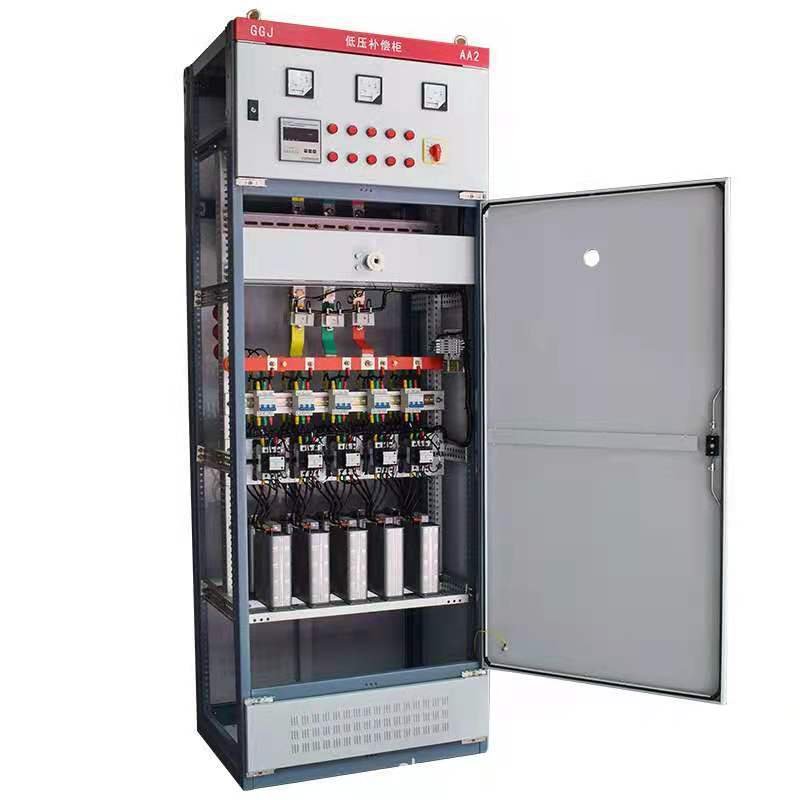
Capacitor bank
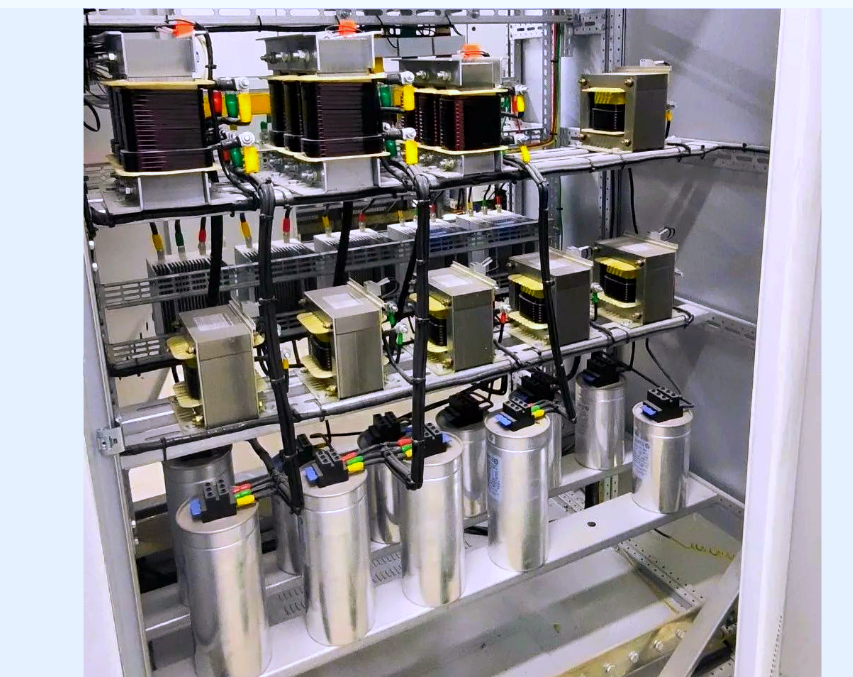
Reactor-equipped capacitor bank
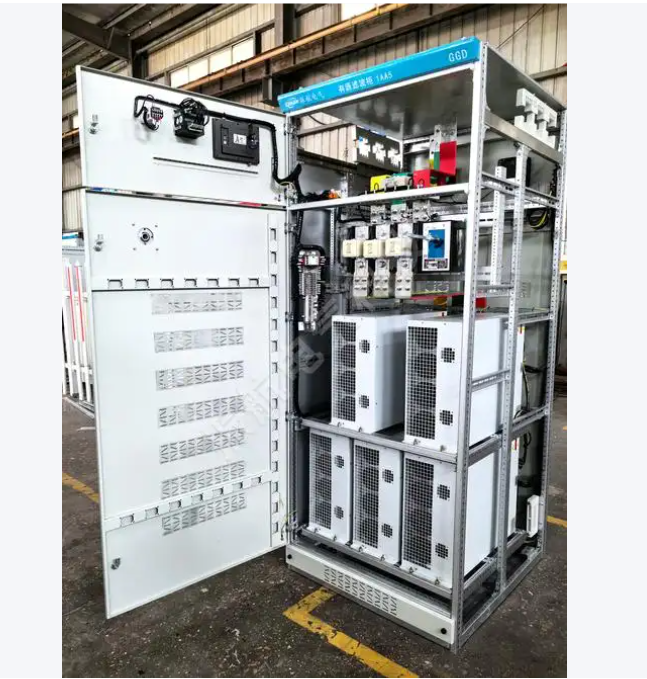
SVG cabinet
3. How should the stages, switching and phase control follow the load?
Two proposals with the same total kVAr can behave differently at low load. Check the smallest available step, the remaining stage sizes and the intended switching sequence. The existing capacity and step-sizing guide explains the sizing considerations; the proposal should show the actual arrangement chosen for the project.
Next, separate the names used for the hardware. They describe different parts of a configuration:
| Description | What it tells you | What it does not establish by itself |
|---|---|---|
| Capacitor-duty contactor | A switching device intended for capacitor duty | Whether its stage rating and switching frequency fit this project |
| Hybrid/composite capacitor switch | A particular switching arrangement whose operation follows its design | That it is equivalent to a fully thyristor-switched stage |
| Integrated smart capacitor | A module combining capacitor and selected control, switching or protection functions | That every model includes a reactor or the same protection and communication features |
| Reactor-equipped assembly | A capacitor arrangement with coordinated series reactors | That it has every harmonic-filtering function requested by the project |
An integrated module is an assembly choice. It can be compared with a discrete capacitor arrangement, but its name does not replace the component schedule. For example, CHINT's BAGB/BAFB catalogue describes integrated functions and different compensation variants; those details must be checked for the selected model.
Also decide whether correction is needed across the three phases together, phase by phase, or in a combined arrangement. Similar reactive demand on each phase and substantially different per-phase demand are different control problems. Provide per-phase readings when imbalance matters, and confirm the proposed topology, sensing and neutral arrangement. Do not infer phase-by-phase capability from the word “smart” or “SVG”.
In a hybrid compensation scheme, “hybrid” means capacitor stages working with an SVG. In a hybrid capacitor switch, the same word refers to the switching device. A quotation should make that distinction clear.
4. What changes when the cabinet reaches the site?
A configuration selected for one operating condition may need different controls or cooling in another. Review the following interfaces before the layout is fixed.
Heat and installation. State the expected room temperature, enclosure location, ventilation restrictions and available maintenance space. Reactor and electronic-module losses need to be included in the thermal review. Adding openings or fans also affects dust protection and maintenance; it is not a substitute for checking the complete arrangement.
For operation after handover, use our capacitor bank maintenance checklist to organize phase-current readings, discharge checks and unresolved findings.
Sensing and existing equipment. Identify the proposed CT location and ratio, the loads included in its measurement, and any existing capacitor banks or filters. A correct controller setting cannot compensate for a measurement boundary that does not represent the intended load. This is a design-review question, not a reason to copy CT wiring from a different cabinet.
Generator operation. Confirm whether compensation must be blocked, reduced or otherwise coordinated when the supply changes. The bank's manufacturer instructions, generator requirements and control scheme govern that decision. Schneider's PowerLogic controller and operating guidance includes requirements for its specified equipment; it should not be generalized into a rule for every bank and generator.
PV or changing import/export conditions. Tell the supplier if on-site generation changes the power flow at the measurement point. Confirm the controller's measurement convention and behavior in the expected modes. A cabinet that works during normal import should not simply be assumed to behave the same during export or an alternative supply mode.
5. What must the proposal say before you approve it?
A request such as “200 kVAr APFC panel” leaves several choices unresolved. The same headline capacity can be offered with different stage arrangements, capacitor ratings, switching devices and document scopes. Compare proposals against the same operating basis.
Use this approval table to turn broad descriptions into statements that can be checked:
| If the proposal says… | Ask it to state… |
|---|---|
| “200 kVAr” | The bank's delivered reactive output at the specified system voltage and frequency, and the stage arrangement |
| “With reactor” | The coordinated reactor/capacitor basis, component ratings and intended harmonic duty |
| “Smart” or “dynamic” | The selected model, switching/control functions and the performance included in the offer |
| “Suitable for the site” | Ambient and enclosure assumptions, cooling method, measurement boundary and supply modes considered |
| “Tested to IEC” | The applicable standards, actual equipment and ratings covered, and which verification and delivery records will be provided |
The last row deserves a specific answer. IEC 61921 addresses low-voltage power-factor-correction banks and relates to assembly requirements where applicable. Agree the standards and evidence for the proposed equipment rather than treating a standard number or laboratory mark as a universal product approval.
The proposal should also identify exclusions and open assumptions: for example, an unavailable harmonic survey, an unconfirmed CT location or a generator operating condition still under review. Resolving these points before production is more useful than comparing two kVAr labels alone.
6. What should you send for a project discussion?
Start with what is available. A useful first enquiry can be short:
System voltage and frequency: …
Normal and minimum operating loads, or the available load schedule: …
Existing and target power factor; required kVAr if already specified: …
Major VFD/UPS loads and available harmonic information: …
Phase-loading information and utility/generator/PV operating modes: …
Installation conditions, quantity and delivery country: …
Attach the single-line diagram and existing measurements when available. Mark unknown items as unknown so that the discussion can identify what needs to be measured or confirmed. The SLD and BOQ preparation guide explains how to organize the wider project documents.
For equipment options and project enquiries, view Zejiefu's APFC capacitor bank panels. The scheme and drawing scope can be discussed against the available project information.