
An MCC for a hot industrial site cannot be selected from the motor schedule alone. The panel builder also needs the temperature at the MCC location, the dust exposure, the enclosure requirement, how the feeders are loaded, and what should happen if cooling fails. Put these in the RFQ and the supplier can check the proposed assembly against them, instead of guessing.
Describe the room, not just the country
"Saudi project" does not tell a supplier whether the MCC will stand in an air-conditioned electrical room, a naturally ventilated building, or an outdoor enclosure in direct sun. These are different design cases.
State the maximum ambient temperature around the MCC, not the weather forecast for the city. Say whether the room is cooled, how likely dust is to enter it, and whether there is condensation or corrosive exposure. If the MCC is outdoors, say so explicitly, because solar load and the outdoor enclosure then need their own review.
Know what catalogue ratings assume
Published MCC ratings come with stated site conditions, and those conditions are narrower than many buyers expect. Siemens' SIVACON S8 planning manual (2015 edition) lists indoor installation, a 24-hour mean ambient of 35 °C, and a range of −5 °C to +40 °C. Rockwell's CENTERLINE 2500 selection guide (2022 edition) states the same −5 °C to +40 °C range with a 24-hour average not above 35 °C, no derating up to 1,000 m, and pollution degree 3. Its selection checklist has a blank for the maximum ambient temperature, which shows that the manufacturer needs this number from you.
These are two products from two manufacturers, not a rule for every MCC. The point for a hot-climate RFQ is simple: give both the maximum temperature and the 24-hour mean at the cabinet, and ask each bidder to state in writing which of its ratings still apply at those values. (Siemens manual; Rockwell selection guide.)
For the assembly itself, IEC 61439-1:2020 sets out general rules for low-voltage assemblies, while IEC 61439-2:2020 gives specific requirements for power switchgear and controlgear assemblies up to 1,000 V AC or 1,500 V DC, for indoor and outdoor use. Confirm which editions and which local or customer additions your project specification calls for. (IEC 61439-1; IEC 61439-2.)
Protection and ventilation pull in opposite directions
A tighter enclosure helps limit dust ingress, and it also limits the air available to carry heat away. The Siemens manual shows the trade-off clearly: its ventilated cubicles reach up to IP43, while non-ventilated cubicles reach IP54. Its vertical-busbar table gives lower current ratings for non-ventilated versions of the listed busbar arrangements. A bare "IP54" in an RFQ therefore says nothing about how the heat leaves the panel.
Ask the supplier to explain enclosure construction, heat-loss assumptions, cooling method and maintenance as one proposal. If filters are involved, ask who cleans or replaces them and how often, because clogged filters reduce airflow over time.
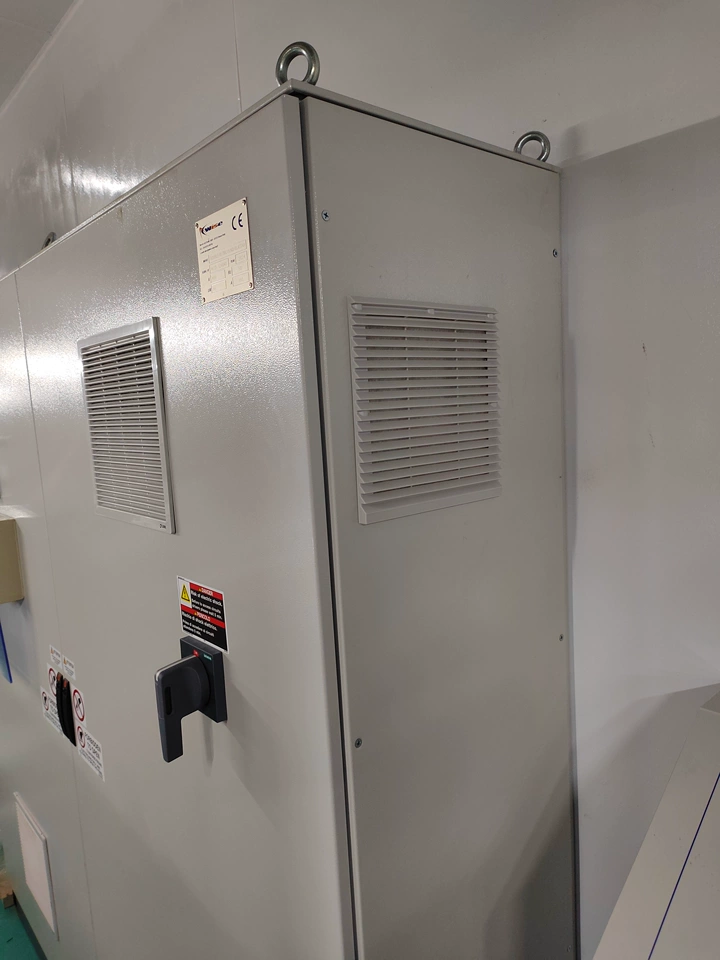
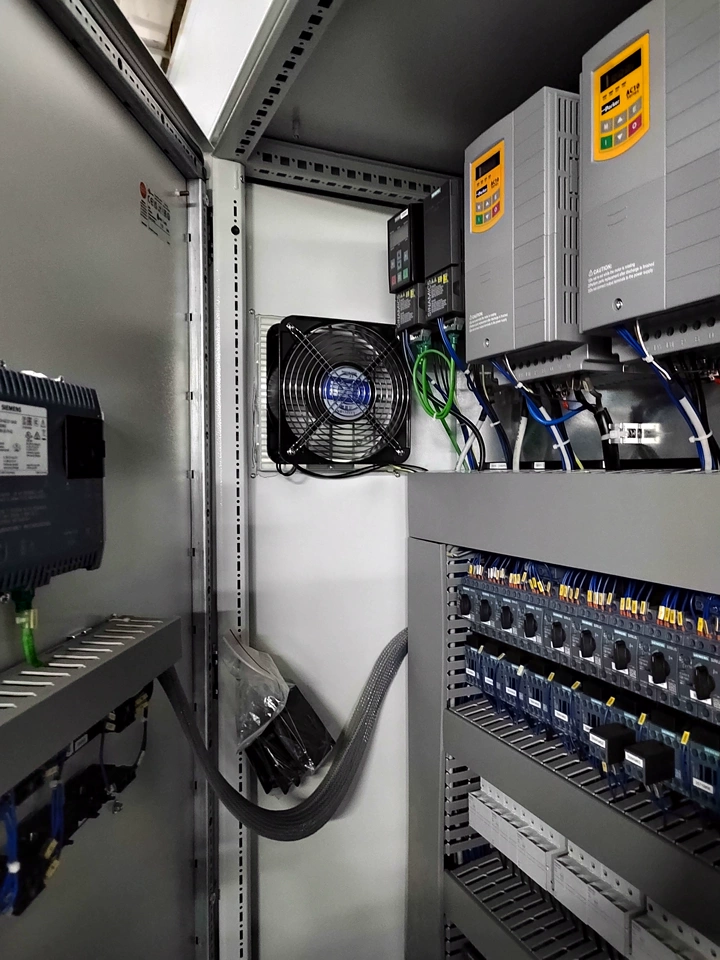
These customer-project photos show a louvered vent on an electrical enclosure and a fan inside it. The filter specification, airflow and resulting enclosure protection must be checked against the actual assembly documents; the images alone do not establish an MCC rating.
Derating belongs to the product, not to a rule of thumb
The same Siemens manual gives temperature correction factors for two different fuse-switch families. At 40 °C one lists 0.95 and the other 0.96. At 55 °C they are 0.80 and 0.85. Two product families from one manufacturer already differ, so a single percentage applied to a whole MCC is not a reliable shortcut.
What matters is what is inside each feeder. Send the motor schedule with rated power or full-load current, starting method, duty cycle and expected simultaneous running. Mark VFD and soft-starter feeders separately, because their heat losses and cooling needs differ from those of a direct-on-line starter. If the starting method is not yet decided, say so and ask for alternatives.
Ask what happens if cooling fails
If the MCC room depends on air conditioning, specify what should happen if that cooling stops. Ask the supplier what cabinet ambient and operating duration its proposal can support under the defined outage condition. State the required duration and whether loads can be reduced or shed. An emergency exhaust fan may delay temperature rise if replacement air is cooler and suitably filtered, but ventilation alone cannot maintain a cabinet temperature below the incoming air temperature. Its effect on dust protection and the enclosure design needs review. (Schneider Electric cooling guidance.)
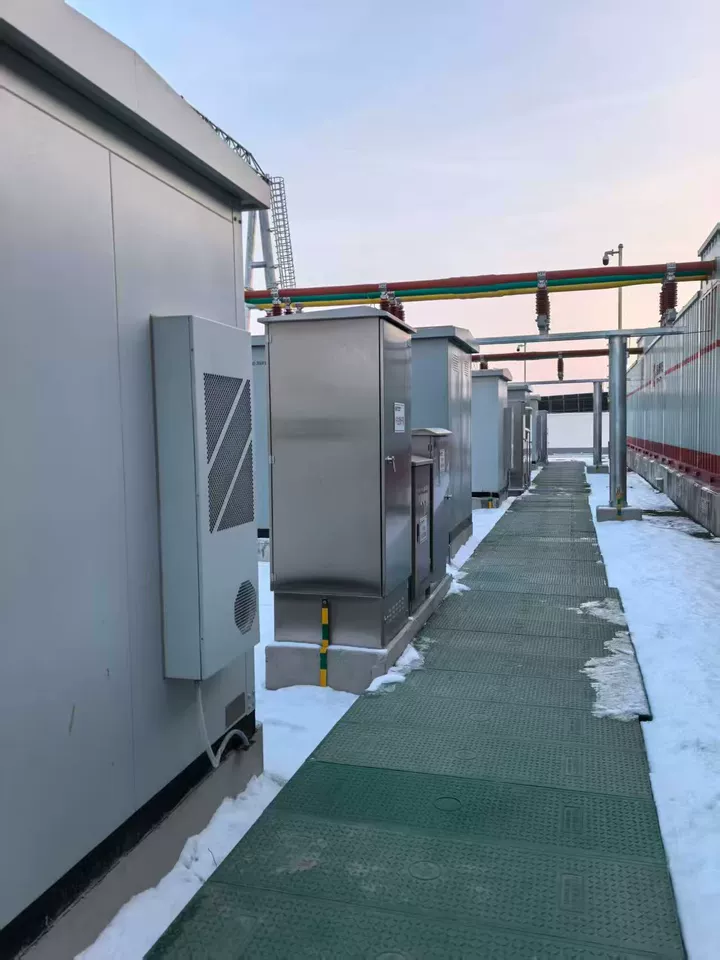
Cabinet-mounted air conditioning is another arrangement. The customer-project photos below show external cooling units fitted to electrical enclosures. They illustrate the installation method; the photographs do not establish cooling capacity, allowable ambient temperature or performance during an air-conditioning outage for an MCC.

Some manufacturers fit fans inside the cubicle for high-loss units. Siemens, for example, describes withdrawable VFD units with forced cooling, sized so that one remaining fan can still do the job if the other fails, with a failure message. The forced-cooled cubicle in that example is IP31; fan redundancy does not establish an IP54 design. This is a feature of one product, not a guarantee for MCCs in general, so ask each bidder what it offers and what it assumes.
Put the decision points in the RFQ
| Project input | What to provide | Why it matters |
|---|---|---|
| Installation | Conditioned room, unconditioned room, or outdoor | Defines the thermal design case |
| Ambient conditions | Maximum and 24-hour mean temperature at the cabinet, humidity, dust | Lets the supplier check component and assembly limits |
| Cooling contingency | Cooling type, longest outage to tolerate, load-shedding plan | Defines whether a degraded case must be checked |
| Enclosure | Required IP rating, cable entry, room filtration | Connects dust protection with heat removal |
| Motors and controls | Motor list, starting method, duty, simultaneous loading | Defines feeder arrangement and internal heat |
| Electrical system | SLD, voltage, frequency, fault level, earthing | Supports protection and assembly selection |
| Project documents | Specification, inspection requirements, preferred component makes | Sets what must be confirmed and documented |
If an item is unknown, write "to be confirmed" rather than guessing.
What a useful supplier response contains
- The ambient temperature (maximum and 24-hour mean) the proposal assumes
- The enclosure type, IP rating and cooling arrangement proposed
- The rated currents used for the main busbars and feeders at those conditions
- How temperature rise was assessed, and the verification evidence for this design
- The effect of cooling failure, if the RFQ asks for it
- Exclusions and items that need customer confirmation
A reply that only says "the panel is tested" without naming the design, the conditions and the evidence does not answer the question.
What Zejiefu needs before proposing a configuration
For a project-specific MCC quotation, send the motor schedule, SLD, site environmental conditions and the technical specification. The Zejiefu MCC product page describes the configurable feeder and control scope, and the SLD and BOQ preparation guide shows how to assemble the input package. Final ratings, components and environmental provisions must be confirmed through engineering review and approved drawings.